
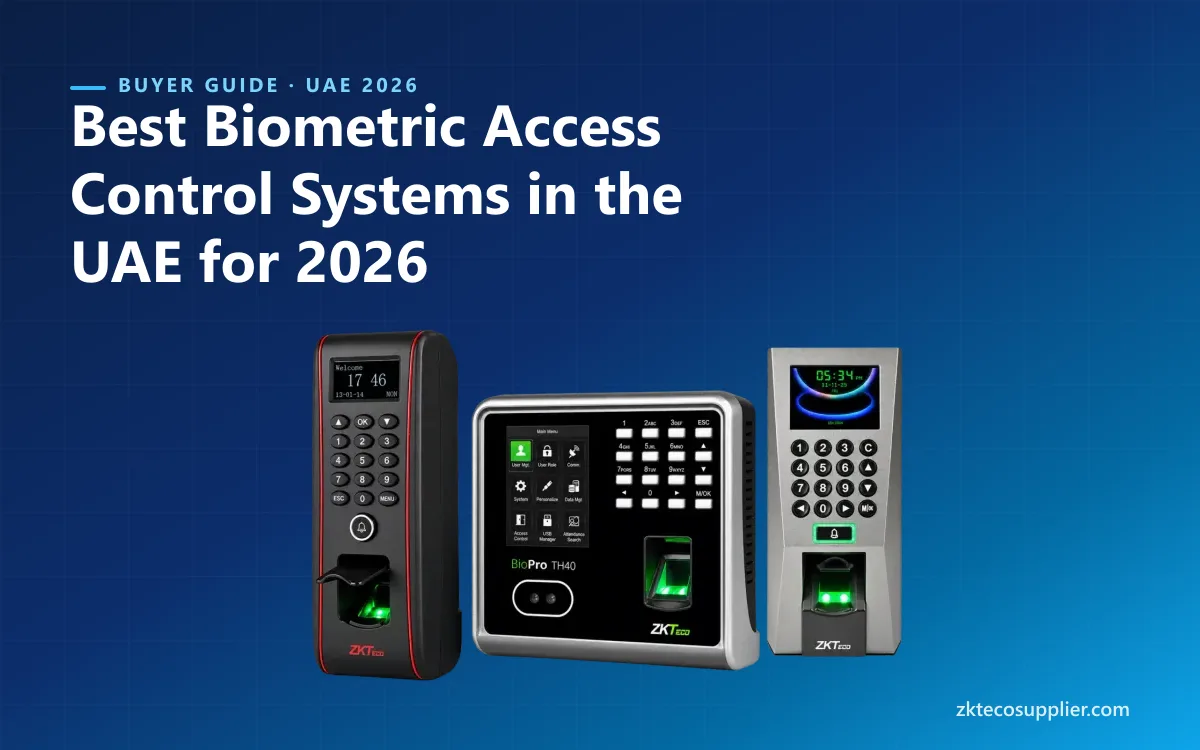
The best biometric access control system for a UAE building depends on three things: how many people pass through each door, the conditions at the door (an air-conditioned lobby, a dusty warehouse or a sun-exposed gate) and the software you need behind it. For most offices in 2026 that means a visible-light face recognition terminal; for small teams a fingerprint terminal is still the most cost-effective; and for outdoor gates you need a weather- and vandal-resistant model.
This guide compares the main biometric methods, matches ZKTeco devices to typical UAE sites and lists what to check before you buy. Every model mentioned is part of our current ZKTeco catalogue.
Fingerprint, face, palm or card: how the methods compare
Each identification method has strengths and weak spots. This is how they behave in typical UAE conditions:
| Method | Speed at the door | Hygiene | Works well for | Watch out for |
|---|---|---|---|---|
| Fingerprint | Fast, one person at a time | Shared contact surface | Small and medium offices, indoor doors | Dry, dusty, wet or worn fingers may not read |
| Face (visible light) | Very fast, touch-free | No contact | Busy offices, hotels, residential lobbies | Strong backlight or direct sun on the camera |
| Palm | Fast; touch-free on palm-scanning models | No contact | High-security doors, second factor | Higher cost than fingerprint |
| Card or PIN | Fast | Shared keypad (PIN) | Visitors, contractors, back-up method | Cards can be lost, lent or copied |
Many ZKTeco terminals combine several methods. The ProFace X [P], for example, reads both face and palm, and multi-biometric models add fingerprint and card. That lets you use face recognition for everyday staff and a card for visitors on the same device.
The right ZKTeco device for each type of site
Corporate offices and co-working spaces
Busy reception areas and staff doors benefit most from touch-free face recognition: staff walk up, the door opens, and attendance is recorded at the same time. Visible-light terminals such as the SpeedFace V5L-P and the G4 suit this use. For server rooms or finance offices, add a second factor such as palm or card.
Factories, warehouses and construction sites
Dusty, oily or worn fingers are the main reason fingerprint readers fail on industrial sites, so face recognition or card readers usually work better here. Where fingerprint is preferred, choose a rugged unit such as the TF1700. For sites without fixed power or network, a portable terminal such as the S922 records attendance in the field; see all portable attendance devices.
Hotels, serviced apartments and residential towers
Guest rooms use RFID hotel locks rather than biometrics, but staff entrances, gyms, pools and back-of-house doors suit face recognition, because cards get lost and shared. Read more about hotel lock systems and smart door locks for apartments.
Outdoor gates and car parks
Sun, heat and sand are hard on readers. Choose a model designed for outdoor installation (the ProFace X is ZKTeco's outdoor, vandal-resistant face terminal) and mount it under a canopy so direct sunlight does not shine into the camera. For vehicles, combine a barrier gate with license plate recognition.
Buildings with many doors or several sites
Once you have more than a few doors, use access control panels instead of standalone terminals. ZKTeco's C3 and InBio panels each control one, two or four doors, and ZKBio CVSecurity manages users, schedules and door logs for all of them from one screen.
What to check before you buy
- Users and records: the device should store more users than you have today, with room to grow.
- Verification speed: at shift change or in a busy lobby, a slow reader creates queues. Face terminals are usually the fastest.
- Environment: for outdoor or dusty locations, choose a model built for it and protect it from direct sun.
- Connectivity: a network connection (cable or Wi-Fi) lets records reach the software automatically.
- Locks and fire safety: doors on escape routes must release when the fire alarm activates. Agree the lock type and fire-alarm interface with your installer and fire consultant.
- Power backup: decide what each door should do during a power cut, and add a backup battery where needed.
- Software: plan it at the same time as the hardware (see below).
BioTime or ZKBio CVSecurity?
BioTime is ZKTeco's time attendance software: shifts, overtime, leave and attendance reports for HR and payroll. ZKBio CVSecurity is the platform for security teams: access levels, schedules, door monitoring and visitor management across many doors and sites. Many organisations use both. Our ZKTeco software guide explains the differences.
Data protection and approvals in the UAE
Fingerprints and face templates are biometric data. Under the UAE Personal Data Protection Law (Federal Decree-Law No. 45 of 2021), biometric data is sensitive personal data, and companies in DIFC and ADGM follow their own data protection rules. In practice: tell staff and visitors what is collected and why, limit who can access the records, and set a retention period. Your legal adviser can confirm what applies to your organisation.
Some security installations in Dubai also need approval from the Security Industry Regulatory Agency (SIRA), depending on the system and the building. Check with your building management before installation.
Get a recommendation for your site
Tell us how many doors and people you have, where the doors are and which software you use today, and we will recommend devices and send a quotation. We supply genuine ZKTeco products from our office in Deira, Dubai, and serve all seven emirates.