
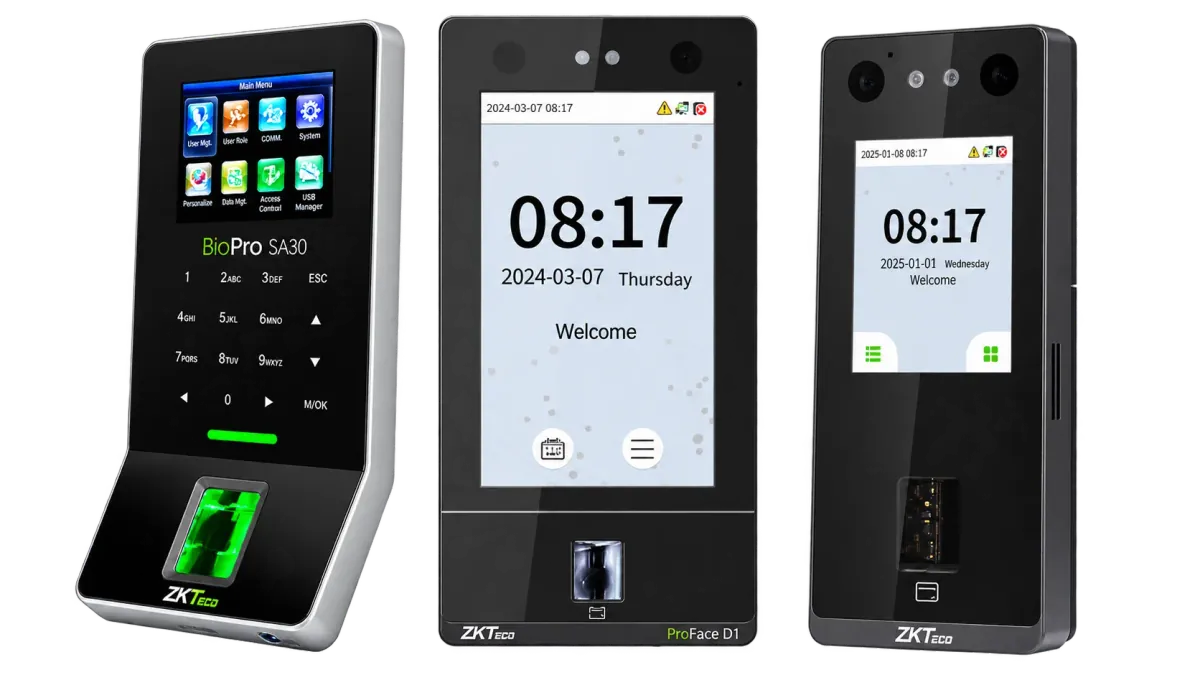
For most UAE workplaces in 2026, face recognition is the better attendance method: it is touch-free, quick at shift changes and not affected by the dry, dusty or worn fingers common in construction, logistics and cleaning. Fingerprint attendance remains the lower-cost choice for small indoor teams, where staff have clean hands and queues are short.
This comparison looks at accuracy in UAE conditions, hygiene, speed, cost and workforce type, then recommends ZKTeco models for each method. All models mentioned are in our current catalogue, and the figures quoted come from their specifications.
How each method works
A fingerprint terminal reads the ridges of a finger on a sensor and compares them with templates enrolled earlier. A visible-light face terminal uses a camera, often dual-lens, to measure the face, and many models check that it is a live person rather than a photo. Many current ZKTeco terminals combine both, with palm and card as further options.
Accuracy in UAE heat and dust
Fingerprint
Fingerprint readers depend on a clear ridge pattern. Dust, cement, oil and paint on the finger, very dry skin from air conditioning, sweat in summer and ridges worn down by manual work all reduce read rates. Office staff rarely have problems; site workers often do. A rugged model protects the device, not the finger: the TF1700 is IP65-rated and specified for -10 to 50 °C, but a worn fingerprint is still hard to read.
Face
Face terminals do not depend on the state of the hands, which is why they suit industrial and site workforces. Their weak spots are strong backlight, direct sun on the camera and heavy dust on the lens. Low helmet brims, masks and sunglasses can also affect recognition on some models, so agree a simple rule at the terminal. Outdoor gates need an outdoor-rated model: the ProFace X [P] is listed as IP68 and IK04.
Heat
Check the operating temperature in the specifications. Many terminals are rated to 45 °C, including the SpeedFace V5L-P (-10 to 45 °C) and the UA300 Pro (0 to 45 °C). Surfaces in direct summer sun get much hotter than the air around them, so mount every terminal in shade, under a canopy or indoors.
Hygiene and speed
Face and palm recognition are touch-free, which matters in clinics, kitchens, food production and any site where many people share one device. A fingerprint sensor is a shared contact surface and needs regular cleaning.
On speed, both methods are quick once the person is in position. The SpeedFace V5L-P and G4 list face recognition at one second or less, and the UA300 Pro lists fingerprint recognition in under 0.5 seconds. The difference at the door is positioning. Face users simply walk up; fingerprint users must place a finger correctly, and a poor read means another attempt. At a shift change with dozens of workers, those retries create the queue.
Cost
Fingerprint terminals are generally the most affordable biometric option, and an entry-level model is often enough for a small office. Face terminals cost more but can save money where failed fingerprint reads lead to manual corrections, disputes and supervisor time. Compare the total cost over several years, including software, installation and maintenance, not only the device price. Our ZKTeco price list gives current guidance.
Which suits your workforce?
| Situation | Recommended method | Why |
|---|---|---|
| Small indoor office | Fingerprint, or face if the budget allows | Clean hands, short queues, lowest cost |
| Busy office or tower lobby | Face | Touch-free and quick at peak times |
| Construction site or labour accommodation | Face, on a rugged or portable unit | Worn and dusty fingers, many workers at once |
| Warehouse, logistics or manufacturing | Face, with card as a backup | Gloves, dust and oil affect fingerprints |
| Clinic, kitchen or food production | Face or palm | Hygiene and gloves |
| Outdoor gate | Outdoor-rated face terminal, in shade | Heat, sun and dust |
| High-security room | Face or palm plus card or PIN | Two factors for sensitive areas |
| Mixed workforce | Multi-biometric terminal | Office and site staff use different methods on one device |
For site-based teams, our page on attendance systems for construction covers portable and outdoor options in more detail.
Recommended ZKTeco models
Fingerprint
- UA300 Pro: up to 3,000 users and 50,000 records, with Wi-Fi, TCP/IP and ADMS for BioTime. A good office attendance terminal.
- X990-C: 3,000 fingerprint templates and 100,000 transactions, with a 3-inch screen. A straightforward attendance clock.
- TF1700: rugged, IP65-rated fingerprint and card terminal with 30,000 card capacity, for doors and sheltered outdoor points.
- S922: portable fingerprint terminal with IP65 protection, a 7,600 mAh battery and 3G/4G or Wi-Fi, for sites without fixed power.
Face
- SFace Lite: compact face and fingerprint terminal with 1,500 face templates, for small teams moving to face recognition.
- SpeedFace V5L-P: face, palm, fingerprint and card, with 6,000 face templates and 200,000 transactions. Suits most offices.
- G4: face, fingerprint, card and password, with a 7-inch screen and a face recognition distance of 0.5 to 3 m.
- BioFace B1: face and fingerprint in an IP65-rated body, with face verification in under 0.35 seconds.
- ProFace X: outdoor, vandal-resistant face terminal with 30,000 face templates as standard, for large workforces and gates.
Why not both?
Multi-biometric terminals let each person use the method that works for them: office staff can use fingerprint or face, site workers face, and visitors a card, all on one device and in one BioTime report. Browse multi-biometric terminals or face recognition terminals, and read our enrolment guide to get the best read rates from either method.
Get a recommendation
Tell us your headcount, shift pattern and where the terminals will be mounted, and we will recommend the right method and model. We supply and install ZKTeco attendance systems across the UAE; see our attendance machines page or request a quote.